

Blog Series: The Real Reasons You’re Stuck | Blog 3 of 4
Quick Answer: Values-based leadership means using your company values as a decision tool, not a poster. When people know which value wins in a trade-off, they can make the call without escalating it to you. It is the system most founders already have and never use, and it protects creativity rather than limiting it. Start by testing your next three decisions against your values.
Before you reach for the classic scaling playbook, systems, processes, and technology, stop for a second. You already have a system. You are just not using it to make decisions with intention.
Most companies have values. Real thought went into them. There was debate. Strong opinions. Sometimes even pride.
And then they sit there. On a wall. Unused.
That is the problem. Values-based leadership is the fix. It takes the words you already believe and turns them into the operating system your business runs on.
What System Do Most Founders Overlook?
When founders worry that scaling properly will kill creativity, the manuals, the policies, the approvals, there is another path. One that protects the culture and still moves the business forward.
Your values are not posters on a wall. They are operational tools.
How Do You Actually Use Your Company Values?
Your core values can and should show up everywhere:
- Hiring
- Onboarding
- Team meetings
- Performance conversations
- Sharing wins and stories
- Post-mortems and learning
- Offboarding
But most of all, in decision-making. Values are the operating system most CEOs actually want. Plenty of business owners are where they are because they wanted out of corporate. They were tired of rules, bureaucracy and endless approvals.
I am not saying the best practices the scaling gurus push are all wrong. And I am not saying you can avoid them forever. But I am bullish that they are not where you should start.
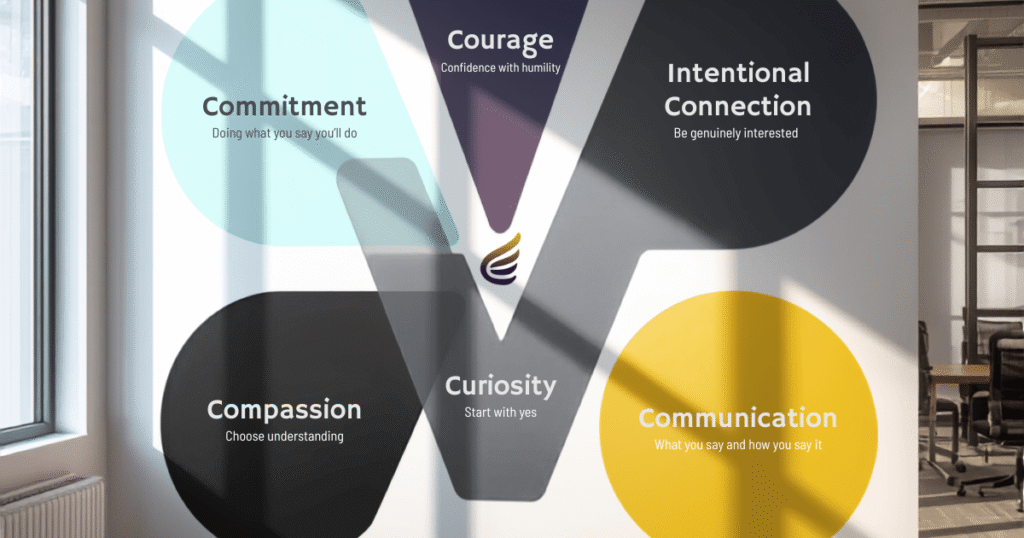
The strongest cultures are not built on policies. They are built on shared values that guide decisions every day. Double U Advisors helps leadership teams turn company values into practical tools that create clarity, strengthen accountability, and allow businesses to scale without losing what makes them special.
Your values are not posters on a wall. They are operational tools. Used well, they are the operating system most founders actually want.
Where Does Values-Based Leadership Break Down?
Values fail when they stay abstract, when they are neither referred to nor used consistently.
They work when you define observable behaviours and what the value looks like in action. What is expected? What gets rewarded. What decisions should it inform? Talk about it often, and it gets sticky.
It is about showing, not telling. Show the team how to use values as a tool, and it becomes the norm. That is values-based decision making in practice.
Just as important: what is not okay.
Build a culture where mistakes happen, but there is a clear expectation to self-identify and correct blind spots. Behaviours that do not align with the values do not become habits. They get called out. People spot it in themselves and others, and they correct and learn from it.
Most people understand what not to do faster than they grasp the aspiration.
When values are explicit, people do not need checklists or documentation to move. They have clarity. They have confidence. They decide without waiting on you.
I recently connected with a client with whom we implemented values-based leadership. They told me stories of decisions they were now reversing and revisiting. Once they had the values at the core of their communication and decisions, they realized they had over-complicated other areas. They had compensated and coddled their people in ways that were confusing, felt heavy, and were unnecessary. Specifically, they had started new brands, which meant new SEO, new websites, new booking systems and confusion about whether the ‘sister’ brand was part of the team or just owned by the Founder. The reason behind this extra cost and workload, and confusion, was to protect the team from fears: stories that were largely out of control because there was a lack of clarity. Those fears proved not to be real once the team got clear on the values. And for those who did have hesitation, they understood and soon became aligned because the decisions, growth and path were transparent. When the values were used to have hard conversations and to show where the business was going, it turned out that those conversations were often not hard at all. The change the client is seeing has quantifiable cost and time savings, not to mention the growth ahead of them and the peace that comes with people who all see where they are going.
FOLLOW US


Do Values Limit Creativity?
There is a fear that structure kills the magic.
Some scaling does. You are not wrong to be afraid of that. We see it all the time. Businesses skip straight to traditional solutions, processes, policies, and systems, and they prematurely lose good people and nimble performance. Day-one advantages disappear before their time.
It is not because the structure is bad. It is that scaling gurus introduce it too quickly, with an impractical arrogance about best practices.
Values create the guardrails that make creativity safer. People know where they can push, experiment, and take risks, without guessing what leadership will tolerate. A values-driven culture turns alignment into momentum.
Values also give teams something to hold themselves to and each other. Done well, it is not about shame or blame. It is a shared language and a shared aspiration.
This takes consistency. Discipline. Leadership is doing the work. And do not discount what that means. They say an important or complex idea needs to be heard at least 7 times before it lands. In a world of shorts and tweets and short videos, that number is higher. Maybe eleven. Maybe thirteen. The point is simple: you need to say it more.
Ironically, I am going to say it again. You are not saying it enough. You are not being heard.
And when you think you have said it enough? You are just getting there. I used to tell executives, “You should feel like you have one foot off a cliff. Say it one more time, and you will want to jump, you find yourself that annoying.”
Say it through multimedia and through multiple voices. Each leader uses the same words. It is a memorization exercise, not a place for everyone to improvise their own version. It should show up in internal newsletters, videos, marketing, the website, emails, meetings, hiring, onboarding and training, team events, and everyday chats. Keep your posters. Add some PDFs and other colourful messaging too.
Done right, your values create lift. Less drag. Less second-guessing. Less founder exhaustion. And a team that feels like home, not friction.
Aren't Values Subjective?
Yes. And the subjectivity is exactly what takes practice. It is why it has to be consistent from recruitment onward. It is why the message is complex and needs repeating.
Too many early-stage and scaling companies jump straight to policies, systems, and technology because those feel objective. Safe. Professional. But without a foundation in values, those investments harden too soon. They create resistance. They reward compliance over ownership. Put in too early, the best practices drain the very energy they were meant to protect.
As decisions get more complex, less reversible, and more material, controls matter. No system alone will be enough. There will also come a point where values alone are not enough. This is not a case against best practices. They are additive when timed correctly.
So what is different in a values-led company? When you start with the system of values before the other systems, you already have trust and a shared language. You have a business designed for the grey. Your team is used to talking about the unexpected. Skip to traditional scaling models, and you are not set up to handle grey well. You build a culture that avoids it, papers over it, or punishes it. Jump straight to systems, and you get compliance at worst, rule-followers at best. Companies built on leading with values start ahead.
Policies tell people what to do when you know the answer. Values help people decide when you don’t.
This Is Not Soft. And It Is Not Fluff.
A value system is tangible. Design it to be measurable and operational. It works at every stage of scale. Values, used properly, are where real structure begins.
That is the heart of values-based leadership: not a poster, a system. The one that lets your business run without everything routing through you.
Up Next: Accountability Isn't About Oversight, It's About Freedom
You are reading Blog Three of The Real Reasons You Are Stuck, a founder-to-owner series on fatigue, flow, and the architecture your business is missing:
- Owner and Founder Fatigue: A Structural Problem, Not a Personal Failure.
- You Don’t Have a People Problem. You Have a Decision Flow Problem.
- Your Values Are More Powerful Than Any Policy: The System Founders Overlook.
- Accountability Isn’t About Oversight, It’s About Freedom: The Three Layers That Scale a Business Without Burning Out the Founder.
Ready to Stop Being the Bottleneck?
If every decision still routes through you, your values are not doing the work they could be.
Two ways to start:
- Start with the diagnostic. Take the DEPEND Assessment. It is a short founder dependency diagnostic across six axes: Decisions, Escalation, Priorities, Energy, Network, and Data. You get a clear read on where you are stuck before you decide what to fix. Take the DEPEND Assessment
- Ready to move faster? Book a Leadership Liftoff call and we will build the plan with you.
About the Author
Jamie L. Smith, CPA, is the Founder of Double U, a fractional leadership company built to help founders and growing businesses unblock growth, regain leadership capacity, and scale sustainably. After years of working alongside business owners, executive teams, and scaling organizations, Jamie built Double U around one core belief: leaders should not do this alone.

FAQs
What is values-based leadership?
Values‑based leadership is using your company values as a working decision-making system, not a wall display. Leaders define the behaviours each value looks like in action, then use them to guide hiring, feedback, and the hard calls. It gives teams a shared standard so they can decide without waiting on the CEO.
How do company values improve decision-making?
Clear values give people a reference point for the grey areas where no policy exists. When the team knows what is expected, what is rewarded, and what is not okay, they act with confidence. That is values-based decision-making, and it pulls decisions off the CEO’s desk.
Do values slow down scaling?
The opposite, when they come first. Jumping straight to process, policy, and systems too early creates resistance and rewards compliance over ownership. A values‑driven culture builds the trust and shared language that make later systems stick rather than stall.
What is the difference between values and policies?
Policies tell people what to do in a defined situation. Values guide people‘s decision-making, including in new situations. Policies handle the known. Values‑based leadership handles the grey, which is most of what a growing business faces.
How often should leaders repeat company values?
More than feels comfortable. A complex idea needs to be heard many times before it lands, and in a noisy world, that number keeps climbing. Use the same words across meetings, hiring, onboarding, marketing, and everyday conversations until it is second nature.