

Blog Series: The Real Reasons You’re Stuck | Blog 4 of 4
A Founder-to-Owner Series on Fatigue, Flow, and the Architecture Your Business Is Missing
Quick Answer: Creating a culture of accountability means your team knows what they own, holds each other to it, and makes decisions without waiting for you. Done right, it is freedom, not micromanagement. It works in three layers: self-accountability, peer accountability and leadership accountability. When all three are in place, the founder stops being the bottleneck and the business keeps moving when you step away.
Accountability is freedom. Not micromanagement. Not compliance. Not control.
Most founders get this backwards. They treat accountability as a last resort, something you reach for when things start to break and people need to step up. So creating a culture of accountability feels like cracking down. It is the opposite.
I remember, as a small business owner, thinking that if I hired strong, mature professionals, imposing formal accountability would be disrespectful. That was the mistake. One of the biggest leadership lessons I have learned is that there is a fine line between chaos and autonomy. Clear expectations are where comfort and clarity live. But expectations without accountability mean very little.
Why Does Accountability Start With Clear Expectations?
Here is what I have learned over the years. Everyone does better with clear expectations.
The rule-followers need the clarity, obviously. But the rule-breakers want to know what they are pushing against. They need it just as much. So do the entrepreneurial, high-performing people who are critical to your team. They want to know the expectation so they can go further, and they want to know when they have overdelivered. Without it, they are just as lost as the person who wants to follow the process and check the box.
Accountability is freedom. For the team, it means acting without waiting. Most founders do not realize it, but they have designed a system that will always bottleneck.
Why Did You Become the Bottleneck?
Look at how the work actually flows through your business:
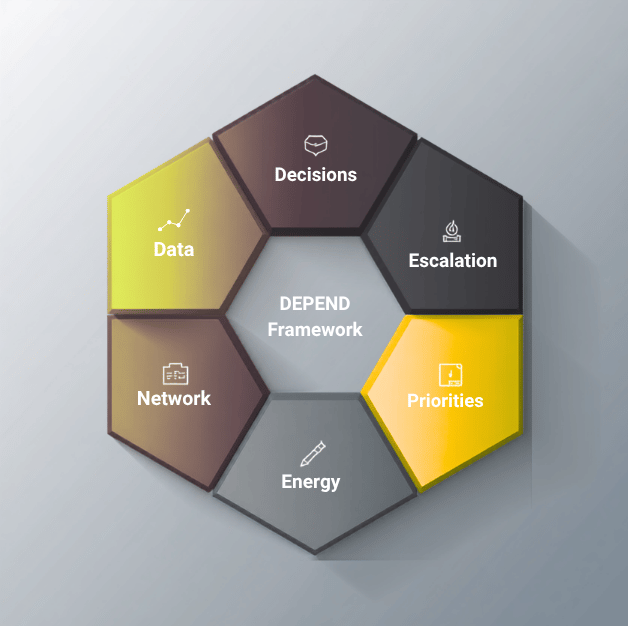
- Decisions run through you
- Escalation is the default. Issues move up instead of getting solved
- Priorities are held centrally
- Energy follows whether you are in the room
- Network is controlled, with the key relationships owned by you
- Data informs you, the founder, not the team, and it does not drive action.
This is what we call DEPEND: Decisions, Escalation, Priorities, Energy, Network, and Data.
DEPEND is not a people problem. It is a design problem. This is the leadership architecture your business is missing.
Answer 18 questions and get a clear picture of what you need to do next
In most systems, the decisions and the confidence stay in your head. Your team waits. They stay dependent rather than accountable. You see the pattern: people hesitate, work slows, and you step in to restore momentum. It works for a day. Then the cycle resumes, and resentment and blame show up next.
- “Why didn’t they just handle it?”
- “Why do I have to be involved in everything?”
- “Why can’t they just think for themselves?”
Take real time away, a retreat, a vacation, a week to focus on strategy, and it becomes obvious. The day you return drowns you in firefighting, questions, and problems. Your plans get derailed. Reacting is the job. Being proactive waits for evenings and weekends.
The issue is not effort, yours or the team’s. The issue is clarity. If people do not know how to decide, they will not. They assume they should not. If they do not feel safe to act, they escalate. And when you have to approve everything, everything waits.

We don’t just place leaders. We build leadership.
Every fractional leader we place is trained in AI, fractional leadership, and intentional connection before they ever work with a client.
Because the right experience matters, but the right leadership mindset changes everything.
When your team knows the why, the what, and the boundaries, they don't wait; they ACT!
What Are the Three Layers of a Culture of Accountability?
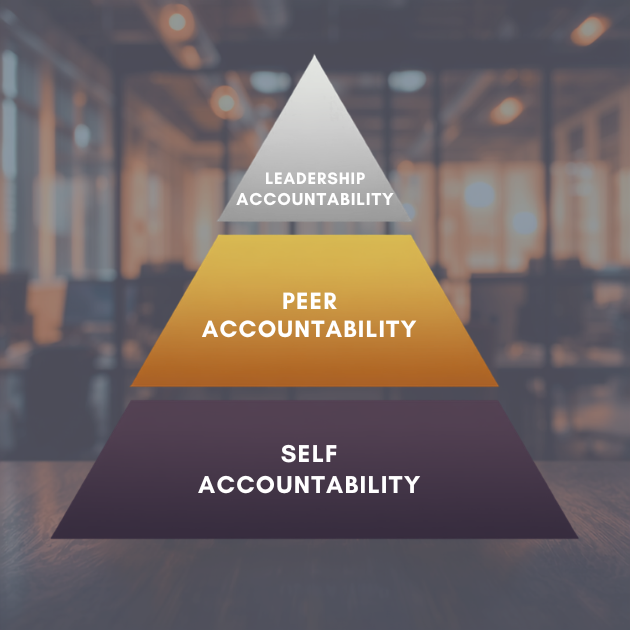
Accountability is not installed. It is built over time. Many companies force in the top layer at a breaking point without first building the foundation. The layers are linear. You need each one, in order, to get it right.
The three layers are self-accountability, peer accountability, and leadership accountability.
Layer One: Self-Accountability
First, people need self-accountability.
With clear values, people have principles to think with. They know to start there when they make decisions. When the standards are high, they know what matters. When decision rights are spelled out, they know their role, and they can act without waiting.
Values are your first set of decision tools. They are where accountability starts. When values are clear and actually used, people do not need constant direction. If I do not know how or when to decide, I cannot hold myself accountable.
FOLLOW US


Layer Two: Peer Accountability
Many companies forget the power of teams holding each other accountable.
Without it, teams escalate instead of solving problems together. It starts to look like tattling, gossiping, or venting. That is draining for leadership and it is unproductive. People wait, defer, and pass problems up instead of across. When accountability only flows up, everything bottlenecks.
When you design peer accountability, problems get solved faster and closer to the outcome. Context gets shared. Ownership expands. If your team cannot hold each other accountable, they will always rely on you. Expect this of the team, and stop swooping in.
Layer Three: Leadership Accountability
Show up as a Business Leader first, and an expert second.
Executives cannot operate as functional or departmental leaders. I have been saying this for years. Yes, you are trained in Human Resources. Yes, you hold the Chief Human Resources Officer title. But when you sit at the executive table, you are a Business Leader first. Leader of Human Resources is second.
It is one of my favourite pieces of common sense, and I did not invent it. For more than sixty years, leadership thinking has pointed the same direction:
- Drucker (1967): executives are accountable for enterprise results.
- Ulrich (1997): functional leaders must become business partners.
- Lencioni (2002): your first team is the executive team, not your function.
- Deloitte (2006 and on): executive roles evolve into enterprise strategists.
- McKinsey (2022): leaders must drop functional bias.
Prominent authors and firms, all landing on the same idea, each in their own words. And that is a small sample.
So look at your leadership. Do you have leaders in a turf war? Are they protecting their silo? Is there cross-functional collaboration? Is there peer accountability? Do they engage in strategy, or just contribute their expertise?
When your executive team is a group of functional leaders and experts, expect a CEO bottleneck. You will see it in slow growth and slower decisions.
Why Does Every Decision Feel High Stakes?
Here is another reason teams hesitate. Everything feels like it matters too much.
Jeff Bezos described two kinds of decisions:
- One-way doors: high consequence, hard to reverse.
- Two-way doors: reversible, low consequence, learn and adjust.
Most businesses treat far too many decisions like one-way doors. They do not pause to weigh the materiality, the real risk, cost, and importance. When every decision feels critical, teams escalate and wait.
High-performing teams move faster because they recognize two-way doors, which, in business, are most decisions. They know when they can decide. They know when they need alignment. And they know when they genuinely need to escalate.
For accountability to thrive, leadership has to make sure everyone understands their decision rights and the escalation process. That clarity is the whole game.
Accountability isn’t about watching people more closely. It’s about building a business that doesn’t have to wait for you.
Accountability Is Freedom
When this works, it does not feel like pressure. It does not weigh you down. It just feels like things are moving again.
People act. Not because they were told to. Because they can. That is accountability.
Where Does Accountability Break, and How Do You Fix It?
If you see your business in this, the fix is not what the scaling gurus will sell you. It does not start with more process or more oversight. It starts with redesign. This is what DEPEND is built to surface, where:
- Decisions are stuck.
- Escalation is the default.
- Priorities are centralized.
- Energy is uneven.
- Network is controlled.
- Data is trapped.
Leadership needs to shift. Accountability does not come from pushing harder. It comes from empowering the team and removing dependence. Set people up for self-accountability. Expect them to hold each other accountable and build a culture of peer accountability. Hold your leaders to a Business Leader first standard. Give everyone clear decision rights and a shared understanding of when to escalate. That is the foundation.
When accountability is real, you are not the bottleneck. You lead a system that runs without your constant involvement, which frees you to focus on the high-impact work that actually moves the business. More freedom with your time. A team operating at its best.
That is creating a culture of accountability. And it is how you stop being the bottleneck.
You are reading Blog Four of The Real Reasons You Are Stuck, a founder-to-owner series on fatigue, flow, and the architecture your business is missing:
- Owner and Founder Fatigue: A Structural Problem, Not a Personal Failure.
- You Don’t Have a People Problem. You Have a Decision Flow Problem.
- Your Values Are More Powerful Than Any Policy: The System Founders Overlook.
- Accountability Isn’t About Oversight, It’s About Freedom: The Three Layers That Scale a Business Without Burning Out the Founder.
Ready to Stop Being the Bottleneck?
You cannot fix what you cannot see.
Two ways to start:
- Start with the diagnostic. Take the DEPEND Assessment. It is a short founder dependency diagnostic across six axes: Decisions, Escalation, Priorities, Energy, Network, and Data. You get a clear read on where you are stuck before you decide what to fix. Take the DEPEND Assessment
- Ready to move faster? Book a Leadership Liftoff call and we will build the plan with you.
About the Author
Jamie L. Smith, CPA, is the Founder of Double U, a fractional leadership company built to help founders and growing businesses unblock growth, regain leadership capacity, and scale sustainably. After years of working alongside business owners, executive teams, and scaling organizations, Jamie built Double U around one core belief: leaders should not do this alone.

FAQs
What does creating a culture of accountability actually mean?
It means building an environment where people know what is expected, know their decision rights, and can act without waiting on you. It is not micromanagement or control. Done right, a culture of accountability gives your team freedom and gives you your time back.
How is accountability different from micromanagement?
Micromanagement is you staying in every decision. Accountability is the opposite. You set clear values, standards, and decision rights, then let people own the outcome. One creates dependence. The other removes it.
What is peer accountability and why does it matter?
Peer accountability is team members holding each other to the standard instead of escalating everything up to you. It solves problems faster and closer to the work. Without it, every issue bottlenecks at the top, which means it bottlenecks at you.
What are the three layers of accountability?
Self-accountability, peer accountability, and leadership accountability. They are built in that order. Skip the foundation and force the top layer at a breaking point, and it will not hold.
How do I know if I am the bottleneck in my business?
If decisions wait for you, issues escalate by default, and your time off turns into firefighting, you are the bottleneck. The DEPEND Assessment shows you exactly where. It is a design problem, not a people problem, and it is fixable.