

Quick answer: To hire an interim leader or fractional leader well, you need to get three things right:
- define the outcome, not the title
- vet for a leader who has solved your problem before
- and set them up to deliver in the first 30 days.
With a firm and a ready bench, you can meet candidates within a week instead of waiting three months or more.
You posted the role. The applications are rolling in.
And most of them are not what you need.
I know how hard it is to hire a senior leader when the seat is already empty. The work does not wait. It lands on you, or on a team that is already stretched.
So how do you hire a fractional or interim leader successfully?
The short answer: get three things right.
- Define the outcome, not the title.
- Vet for their ability to make decisions and solve problems because they’ve seen them before.
- Set them up to deliver in the first 30 days.
Get those right and you can have a proven leader in the seat in weeks, not months. Get them wrong, and you will be reposting the role by the next quarter.
Fractional vs Interim vs Contract: What Is the Difference?
The words get used loosely. Here is how we use them.
| Fractional | Interim | Contract or project | |
|---|---|---|---|
| Time | Part-time, often 1 to 3 days a week | Full or near full-time | Varies |
| Length | Ongoing, contract lengths vary | Fixed period: a leave, a departure, a transition | Until the deliverable is done |
| Role | Embedded leader who owns outcomes | Holds the seat and keeps things moving | Delivers a defined project |
| Best for | Senior capability you cannot justify full-time | A seat that cannot sit empty | A clear, scoped piece of work |
Many roles posted as “contract” or “term” are really a fractional seat in disguise. That is exactly why the usual hiring playbook breaks.
Why Does the Usual Hiring Playbook Fail Here?
Many of our clients struggle with the same thing. They run a fractional or interim hire like a full-time search, and it stalls.
- Senior searches are slow. Executive search benchmarks suggest budgeting about 2.5 to 3.5 months for Director roles and 3.5 to 4 months for Vice President (VP) roles (Talentfoot, 2026).
- Job boards attract the wrong pool. A contract posting draws people bridging to their next full-time job. That is not the same as a leader who has built a fractional practice.
- The best fractional leaders may not apply. They are often booked through firms, referrals and networks, not job boards.
The fix is not a better job post. It is a better process.
Step 1: Define the Outcome, Not the Title
Before you look at a single candidate, answer four questions:
- What must be true in 90 days? Name two or three outcomes, not a list of duties.
- What will this leader own? Which decisions, which team, which budget. Sometimes it is not a deliverable. It is accountability and responsibility.
- How many days a week does the work actually need? Be honest. Many “full-time” seats need two or three strong days.
- Who do they report to, and how will you know it is working?
If you cannot answer these, work with a recruiter or firm to get clarity.
Step 2: Vet an Interim or Fractional Leader for Fit and Speed
A great fractional or interim leader lands fast. Look for:
- They have done it before. A leader who has faced a challenge will be ready to solve it again. You do not pay for development and learning with a fractional or interim hire.
- They have worked in client service before. They know how to earn trust quickly and work across more than one priority. A proven approach lets them hit the ground running.
- Values fit. Skills get them hired. Values decide whether they last. Just because they are not a full-time employee does not mean culture and fit do not matter.
Red flags:
- Advises but will not own outcomes.
- Cannot explain how they would spend the first two weeks.
- A calendar so full you would get leftovers.
- Wants the title more than the work.
- Is on an interim career pivot while they find their next permanent role.
- No references from a fractional or interim client.
Step 3: Set Them Up to Deliver in 30 Days
The first month decides the engagement. Give them:
- Relationships. Help them get to know you and the organization, and set them up to earn your trust and the team’s.
- Clear decision rights. What they can decide without you.
- Access on day one. Systems, people, data. Waiting a week for a login wastes a week.
- An action plan, agreed together within 30 days with two or three early wins.
- An invite. They participate as an embedded team member and attend leadership meetings where they report and challenge priorities.
A well-set-up leader becomes part of your team, not a visitor.
How Does a Fractional or Interim Leader Compare to an Employee?
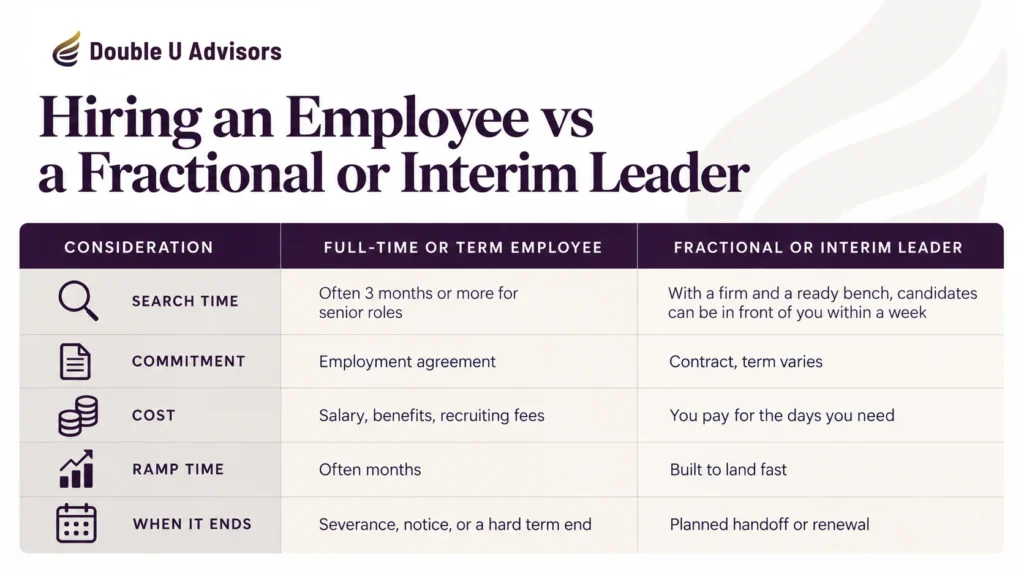
One practical note: a fractional leader works under a service agreement, not an employment agreement. Check contractor rules with your own advisor.
Should You Hire It Yourself or Use a Firm?
Doing it yourself works when:
- You have a strong network in that function and a few names already in mind.
- You have defined the outcome clearly (Step 1).
- You have the extra time and the recruiting skills in-house to screen, check references and negotiate terms.
A firm helps when:
- The seat is already empty and every week costs you.
- You do not know what good looks like in that function, so it is hard to tell a strong leader from a strong interviewer.
- Past hires did not stick, and you need fit screening, not just a résumé match.
- You want someone accountable if the match does not work.
- You run lean and do not have recruiting expertise.
- You do not have a network of trusted referred candidates.
A firm does not always cost more than doing it yourself. In many cases, a firm’s margin is a reduction of the contractor’s regular rates. Contractors value the matching because it saves them business development, marketing and sales costs and time. The firm also supports them with client service and back-office support.
With a firm, you are buying speed, a vetted bench and a second set of eyes on fit. You get the firm’s cumulative experience, which often includes training, standards, a network, and additional support. Weigh that against the cost of the seat sitting empty, or of hiring the wrong leader twice.
What Good Looks Like:
Picture the seat filled a month from now.
Decisions are moving again. Your team knows who to go to. The work that was landing on your desk has an owner.
And if this is leave coverage, the person returning comes back to a stronger team, not a backlog.
That is what the right fractional or interim leader, set up well, gives you.
How Double U Helps
We know how hard it is to find the right leader when the clock is ticking. So we do the heavy lifting:
- A Right Fit call to define the outcome and scope the seat. A proposal usually follows within a day.
- We recruit from our bench of vetted fractional and interim leaders across North America.
- You meet three to five candidates within a week of signing and pick the one who fits.
- An action plan within 30 days, so your leader is delivering from the start.
Jamie is always so quick to respond and always has our best interests at the forefront when presenting solutions/options. I appreciate having a trusted advisor!
Trina Mckay, Bow Valley Credit Union
Your Next Step
Have an open seat? Book a Right Fit call. In 20 minutes, we will tell you whether fractional or interim fits, and how fast we can help.
Still deciding between fractional and full-time? Read When Does a Business Need a Fractional Executive?
About the Author
Written by Jamie L. Smith, CPA, founder of Double U Advisors. Jamie co-founded one of Canada’s first fractional executive firms, and has spent her career matching experienced leaders with growing businesses.

FAQs
How long does it take to hire a fractional leader?
With a clear outcome and the right network, often weeks rather than months. At Double U, a proposal usually follows the Right Fit call within a day, and you meet candidates within a week of signing. Traditional senior searches commonly take three months or more.
Can a fractional leader cover a maternity or parental leave?
Yes. In Canada, a parental leave can stretch to 18 months. A fractional or interim leader can hold the seat, keep the team moving and hand it back cleanly when your leader returns.
What is the difference between a fractional and an interim leader?
A fractional leader works part-time on an ongoing basis. An interim leader fills a seat full- or near full-time for a fixed period, such as a leave or a departure.
How much does a fractional leader cost?
It depends on seniority and days per week. You pay for the time you need, without the salary, benefits and long-term commitment of a full-time hire.
What should I look for when I hire a fractional executive?
Look for experience at your stage, a track record in fractional or interim roles, values fit, and a clear plan for the first 30 days.