
Blog Series: Fractional Leadership Boom Series | Blog 3 of 6
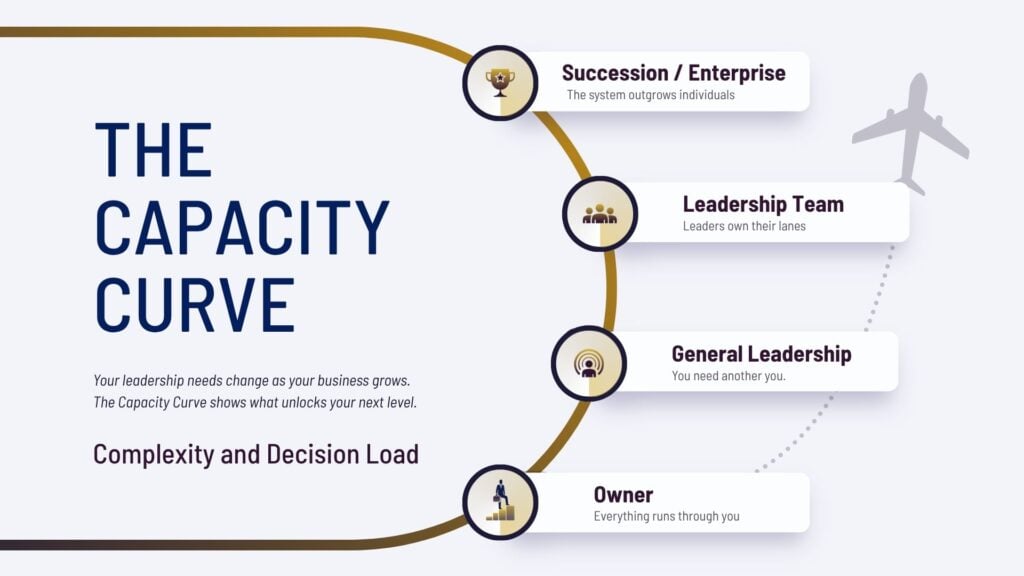
Quick Answer: A business needs a fractional executive when the CEO has become the bottleneck: days lost to firefighting, decisions piling up, and growth slowing because everything runs through one person. It usually shows up once you need senior capacity but a full-time executive at over $200,000 a year is too much, too soon. Double U Advisors uses the Capacity Curve to pinpoint which role to add first.
Many of our leaders struggle with the same pattern. You get to your desk with a plan. Next thing you know, the day runs away on you. You lose it to firefighting, solving problems, answering questions, and making decisions.
So when does a business need a fractional executive?
The short answer:
- when growth is outpacing you
- you have become the bottleneck
- you need senior leadership you cannot yet justify hiring full-time
We call this the Chief Executive Officer (CEO) bottleneck. The business needs capacity. You need your time back. That is what fractional-ready looks like.
This cycle is common. CEOs get pulled back into the functions they love or do best. We see CEOs spending their days in the weeds of Operations, Sales, Marketing, and People. Yet these businesses are far too complex to rest on the shoulders of one person. And CEOs need energy for vision, strategy, and leadership.
The shift is real. The number of people identifying as fractional leaders on LinkedIn went from about 2,000 to more than 110,000 in two years, according to Harvard Business Review.
If you are unclear where the dependencies are, or which function is the gap, start with a leadership diagnostic before you solve with people.
This is not just our view. Harvard Business Review reports that fractional roles work best when a company first defines the work it actually needs, rather than hiring for a title it assumes it should fill.
Fractional leadership is not one-size-fits-all. Its impact depends on timing and fit. The Capacity Curve helps you see when a fractional role accelerates growth and when it will not move the needle.
What Is a Fractional Executive?
A fractional executive is an experienced senior leader who joins your leadership team part-time. They own a function, like operations, sales, marketing or HR, and make real decisions inside it. You get executive leadership for a fraction of the time and cost of a full-time hire.
Why Do CEOs Know They Need Help but Not What Kind?
Few CEOs walk in our door saying, “I need a fractional Chief Operating Officer (COO).”
Most say things like:
- Why am I still doing everything?
- My team waits on me for every decision.
- I need to get out of firefighting.
- I cannot see the way ahead.
The overwhelm is not a lack of talent or ambition. It is the collision of complexity, decision load, and leadership capacity.
Misdiagnose this stage, and you hire the wrong role, or the right role at the wrong time.
That is where leaders stall. Not for lack of effort. For lack of clarity on what is actually needed.
How Do You Know if Your Business Is Ready for a Fractional Executive?
Each stage of the Capacity Curve has its own needs and signals. Knowing yours helps you align the right support.
Stage 1: $0 to $2M. OWNER-MANAGED AND OVEREXTENDED
At this stage, the owners are the leadership team. Too many hats. Too many decisions.
Fractional executives are usually premature here. The business is still simple. The model is still being finalized, and the founder is needed at all levels to fine-tune. But help still matters.
Most value comes from:
- Clear priorities
- Decision frameworks
- Defined roles
- Basic leadership infrastructure
Signals you are here:
- Nearly every decision flows through the owner
- The team is still small (under 10)
- Constant firefighting
- Delegation is a struggle
Most effective support: leadership diagnostics, targeted advisory, business coaching, and foundational leadership work.
Stage 2: $2M to $8M. YOU NEED ANOTHER YOU
Growth has come fast. Structure is lagging. The CEO becomes the bottleneck.
This is the inflection point where fractional leadership has the most impact. Especially generalists who can build systems, lead people, and restore capacity fast.
Signals you are here:
- You cannot unplug without things slowing down
- Managers rely heavily on you
- Processes are half-built or undocumented
- You are trapped in coordination
- Strategy keeps getting crowded out by execution
Most effective support: a generalist fractional leader, often one day a week.
Stage 3: $8M to $20M. THE MESSY MIDDLE
Now you have functions and departments. More complexity. More misalignment.
“Another you” is no longer enough. You need specialists who can scale functions.
Signals you are here:
- Siloed teams
- No visibility into performance
- Managers need maturity, not instructions
- You need execution and structure across functions
Most effective support: fractional specialists across Operations, Sales, Marketing, and People. These leaders show up as business leaders and bring structure, accountability, and capability where your growing departments need it most.
Stage 4: $20M AND UP. SUCCESSION, SPECIALIZATION, AND MODERNIZATION
Fractional support still matters, but the job shifts. It becomes about:
- Developing successors
- Professionalizing performance
- Modernizing systems and decision frameworks
- Implementing artificial intelligence (AI), data, and operating improvements
- Bringing in specialist expertise for transformation
At $50M and up, companies often move toward full-time senior roles, with fractional experts supplying targeted execution, coaching, or modernization.
Most effective support: specialists, executive mentors, business coaching, and transformation-focused fractional roles.
We have not met a client who has not seen themselves go through these stages. Just the other day, Seth Godin was on the Mel Robbins Podcast talking about how freelancers differ from entrepreneurs, and how a freelancer gets paid to do work while an entrepreneur builds something bigger than them. You can use any language you want, but his point was that many business owners see themselves as the latter but do not use assets and instead hire the best available, cheapest person, which is often themselves. You can build a great lifestyle either way, but if you continue to do it all yourself, you will fail to build an actual business. (Mel Robbins Podcast, Seth Godin)

You do not need a fractional executive when you are busy. You need one when you have become the bottleneck and growth is outpacing your capacity.
Which Leadership Role Removes the Bottleneck Fastest?
One of the biggest reasons CEOs stall is not knowing which role removes the bottleneck fastest.
- A COO to stabilize the business and install structure?
- A fractional Chief Marketing Officer (CMO) to build a real pipeline?
- A fractional Chief Revenue Officer (CRO) to create accountability for revenue?
- A fractional Chief Human Resources Officer (CHRO) to professionalize people leadership?
- A Chief of Staff to extend your executive capacity?
- Or a generalist, because the real issue is everything, everywhere, all at once?
If you are unclear, you are not alone.
Most CEOs do not know the exact role they need until they run a leadership diagnostic. A framework like the Capacity Curve helps you see whether you need capacity, capability, or specialization, and in what order.
FOLLOW US


What Are the Signs You Need a Fractional Executive?
You are fractional-ready if:
- You are the bottleneck
- Growth is outpacing your leadership bandwidth
- You need senior expertise but cannot justify full-time
- You are stuck between big decisions and constant execution
- Unclear ownership, accountabilities, or capacity gaps are slowing the business down
You may need a plan first if:
- You are unclear what role is actually needed
- Prioritization, not people, is the real issue
- Roles, responsibilities, or key performance indicators (KPIs) are not defined
- There is no foundation for a leader to plug into and operate effectively
In those cases, a diagnostic and leadership alignment process saves time, money, and mis-hires.

The Right Leader Starts with the Right Decision.
The biggest leadership mistake isn’t hiring too late. It’s hiring the wrong role. We help CEOs identify what’s actually holding their business back before recommending the leadership support that will create the greatest impact.
Fractional or Full-Time? Be Confident About What the Seat Needs
Not every gap needs a new full-time hire. And not every gap should be fractional either.
Here is our candid view, after years of placing leaders.
When fractional or interim beats a full-time or term hire:
- A leader is on leave. A parental leave can stretch to 18 months. A term hire means recruiting, onboarding, and losing them right as they hit their stride. Strong leaders rarely leave a permanent role for a temporary one. A fractional or interim leader holds the seat, keeps decisions moving, and hands back a stronger team.
- A leader left suddenly. Do not rush a permanent hire just to stop the bleeding. An interim leader stabilizes the team while you decide what the seat should become.
- The search is stalling. Senior searches commonly take three months or more. Every month the seat sits empty, the work lands on you.
- The work is real, but it is not five days a week. Many seats need two or three strong days. Paying for five buys you a less senior leader, not more leadership. Or it creates drift and piles too many hats or priorities onto a single hire, when focus and expertise at a fractional level would deliver more.
- You need a builder, not a maintainer. A fractional leader builds the function, then helps you hire and onboard the permanent leader to run it.
- You are building internal succession and want to grow the next leader from within. Filling the gap and investing in mentoring and coaching can save money and properly prepare the loyal high performer.
When full-time is the better answer:
- The seat needs daily presence, such as running a large on-site team every day.
- The function is mature, and the load is steady at full-time.
- You are large and complex, and the role is a permanent part of your leadership team.
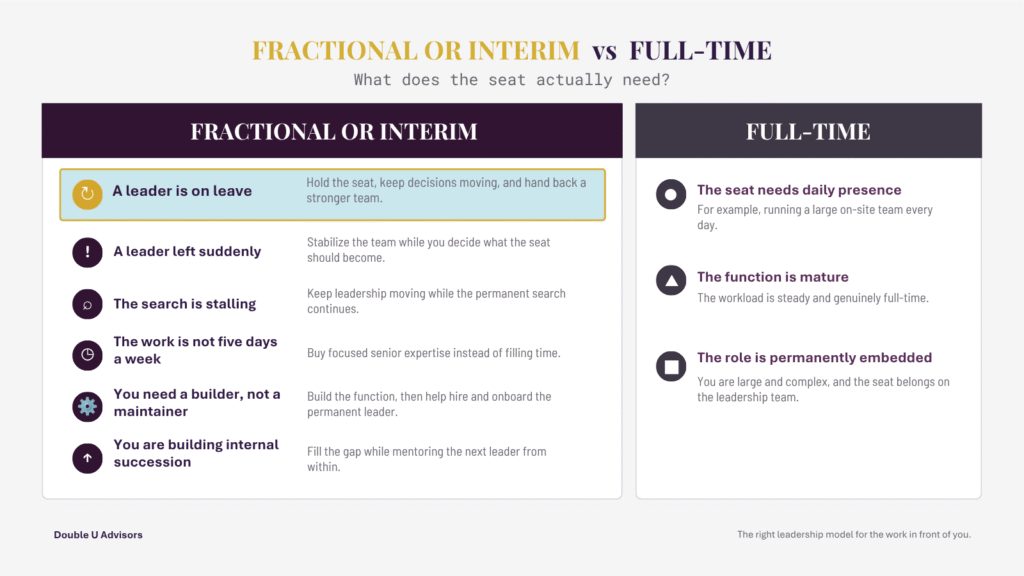
Here is the same guide as a table: what does the seat actually need?
| Choose | When | What it looks like |
|---|---|---|
| Fractional or interim | A leader is on leave | Hold the seat, keep decisions moving, and hand back a stronger team. |
| Fractional or interim | A leader left suddenly | Stabilize the team while you decide what the seat should become. |
| Fractional or interim | The search is stalling | Keep leadership moving while the permanent search continues. |
| Fractional or interim | The work is not five days a week | Buy focused senior expertise instead of filling time. |
| Fractional or interim | You need a builder, not a maintainer | Build the function, then help hire and onboard the permanent leader. |
| Fractional or interim | You are building internal succession | Fill the gap while mentoring the next leader from within. |
| Full-time | The seat needs daily presence | For example, running a large on-site team every day. |
| Full-time | The function is mature | The workload is steady and genuinely full-time. |
| Full-time | The role is permanently embedded | You are large and complex, and the seat belongs on the leadership team. |
If you are unsure, that is normal.
The Right Fit call answers exactly this question.
Where This Framework Fits in Your Leadership Path
The Capacity Curve is not about selling fractional services. It is a lens to help CEOs stop guessing.
The right first step depends on your stage:
- Leadership Liftoff or diagnostic: when you are not clear on what you need
- Fractional generalist: when you need capacity
- Fractional experts: when departments need maturity and structure
- Coaching, advisory, succession, and specialists: when the organization needs modernization or next-level capability
Fractional readiness is not a gut decision. It is a leadership capacity decision.
What Does Fractional-Ready Actually Feel Like?
Picture the version of your business that does not wait on you.
Decisions move without your sign-off.
Your managers own outcomes.
You spend your week on vision and growth, not firefighting.
That is what the right fractional leader, brought in at the right stage, is built to give you.
Fractional readiness isn’t a revenue decision. It’s a leadership capacity decision.
Your Next Step
Not sure which stage you are in? Start here.
Soft entry: Take the DEPEND Assessment. A short diagnostic to see exactly where you are the bottleneck. Take the DEPEND Assessment
Ready to move: Book a Leadership Liftoff call and leave with clarity, a plan, and execution support.
Have an open seat right now? Book a Right Fit call, and we will tell you whether fractional, interim or full-time fits.
More in the Fractional Leadership Boom Series
You are reading Blog Three of The Fractional Leadership Boom Series.
What’s coming next:
- Why Demand Is Exploding: And What Most People Still Get Wrong
- The Hidden Advantage: How Embedded Fractional Executives Outperform Full-Time Hires
- Is Your Business Fractional-Ready? A Leadership Diagnostic for CEOs
- Why AI-Enabled Fractional Leaders Are the Future of Leadership Development
- The Fractional Role Map: How to Choose the Right Leadership Support for Your Stage (which C-suite seat: COO, CMO, CHRO, CRO/CGO?)
- How SMEs Scale with Fractional Leadership (Without Breaking Their Team)
About the Author
Jamie L. Smith, CPA, is the Founder of Double U, a fractional leadership company built to help founders and growing businesses unblock growth, regain leadership capacity, and scale sustainably. After years of working alongside business owners, executive teams, and scaling organizations, Jamie built Double U around one core belief: leaders should not do this alone.

FAQs
When does a business need a fractional executive?
Your business needs a fractional executive when growth has outpaced your capacity, you have become the bottleneck, and you need senior leadership you cannot yet justify full-time. Most owners feel this most between $2M and $8M in revenue.
What are the signs you need a fractional COO?
Signs you need a fractional COO include managers relying on you for every decision, half-built or undocumented processes, and strategy getting crowded out by day-to-day execution. If you cannot unplug without things slowing down, that is the clearest signal.
How do I know if my business is fractional-ready?
You are fractional-ready if you are the bottleneck, growth is outpacing your leadership bandwidth, and you need senior expertise you cannot justify full-time. If you are unclear which role you need, you may need a diagnostic and a plan first.
When is it too early to hire a fractional executive?
It is usually too early below about $2M in revenue, when the business model is still being finalized and the founder is needed at every level. At that stage, clear priorities, decision frameworks, and defined roles deliver more value than a fractional hire.
Do I need a fractional leader or a full-time hire?
Choose fractional or interim when the seat is temporary (a leave or a departure), the search is stalling, or the work does not need five days a week. Choose full-time when the seat needs daily presence and steady full-time load.
Can a fractional leader cover a maternity or parental leave?
Yes. Parental leave can stretch to 18 months, which makes a term hire hard to fill and harder to keep. A fractional or interim leader holds the seat, keeps the team moving, and hands it back cleanly when your leader returns.