

Blog Series: The Real Reasons You’re Stuck – Blog 2 of 4
A founder-to-owner series on fatigue, flow, and the architecture your business is missing.
Creating a Culture of Accountability Starts with Decision Flow
The bottom line: if every decision routes back to you, the problem is rarely your people. It is your leadership architecture. The fix is creating a culture of accountability that lets your team decide without you.
There is a moment every owner hits. Your patience cracks and the truth slips out: “Why can’t my team just take things and run?”
You are not wrong for thinking it. You are not alone either. I have felt it. I hear it from friends, in peer forums, and from clients. The old line “more people, more problems” rings true for most owners.
You add people. You expect relief. Instead your workload grows while everyone circles you like air traffic.
You hired to get out of the weeds. Somehow you ended up deeper in them.
Most leaders genuinely care about their people. They want to develop them. They want a strong team.
And they still feel stuck:
- I hired more people. Why am I busier?
- I have to do it myself, or it does not get done right.
- I am the only one who sees the whole picture.
The irony stings. Your team is the whole point, yet they cause the most stress and take up most of your thoughts. So you stay close to the big clients and the hard calls. You feel like you are losing control, so you grip harder.
Sound familiar?
I loved my epic team. I miss them. It is the hardest part of selling. Yet, when I was a bottleneck, I remember moments of frustration. The Christmases when people would quit. Hiring during that time, with notice periods that were extra short because they covered the period when the office was practically closed, was one of my least favourite moments and one that I had to step in to solve alone in the early days. I also recall hiring on the streets of Kelowna while my girlfriends giggled in a shop and did a shopping spree without me. Or hiring on the streets of Banff in a similar moment. And maybe once in a pool in Mexico? Clearly, hiring was my longest-serving bottleneck. And obviously, I was lucky to be in amazing places and working. But it wore on me, just as it does to any CEO or business owner.
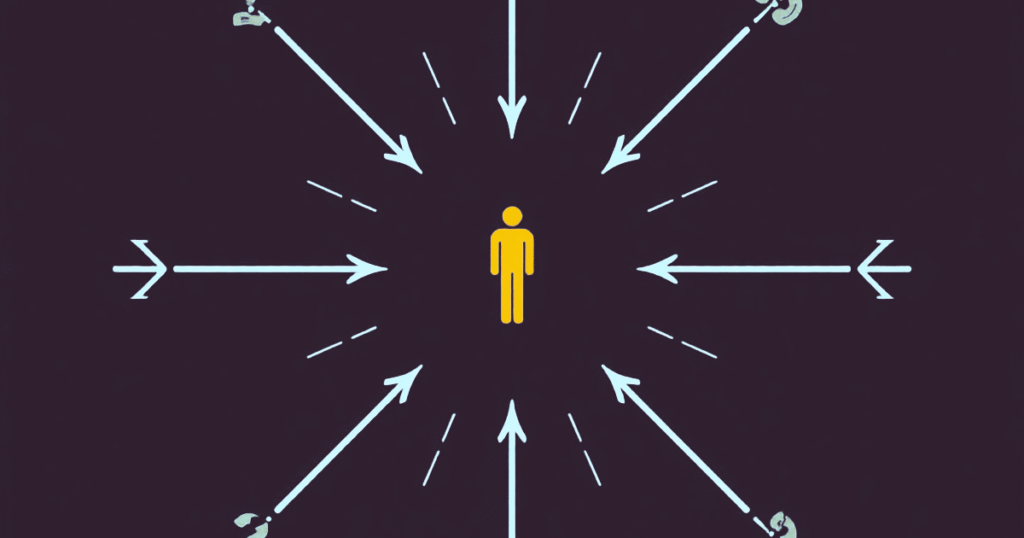
At some point, every growing business faces the same challenge: too many decisions flowing through too few people. Double U Advisors helps leaders create the accountability, clarity, and leadership capacity that allow teams to operate with confidence, reducing founder dependency and creating a business that can scale.
Here Is What Actually Happens Behind the Scenes
Most owners reach for two explanations when things slip:
- My team is not strong enough
- I am failing as a leader
Neither is the real issue.
You cannot blame your people, and you are not the villain either. I have worked with enough owners to tell you the truth: things fall apart when decisions are unclear, not when people are incompetent.
Your team is not avoiding ownership. You can see it. They are busy. Maybe not always on the right things, but they are not lazy. They are trying to avoid rework, wasted time, and contradicting what you “meant”, but did not say.
So they ask.
They wait.
They check in.
They follow up.
They route everything back to you.
Not because they are the wrong team. Because you are the only stable decision point in the business. And when a growing business has a single stable decision-making point, that point becomes the CEO bottleneck.
When a growing business has one stable decision point, that point becomes the bottleneck.
Why Adding People Multiplies the Chaos
When the decision flow is unclear, more people does not mean more help.
It means more load on you:
- More people means more questions
- More questions means more work for you
- More work for you means more fatigue
- More fatigue means more fear of letting go
That is how owners end up doing work they have no business touching. Not because the team is weak. Because the design cannot hold the weight of growth.
FOLLOW US


Why Systems Will Not Save You Yet
When owners get desperate, the next reflex is predictable: We need systems. Standard operating procedures. Documentation. More structure.
Here is the problem.
Systems without clarity slow everything down. And the fear of going corporate and losing your magic is real. Jump straight to heavy process, and you get:
- approvals for the sake of approvals
- process for the sake of process
- meetings that breed more meetings
- documentation no one reads
- a team that disengages because the work feels heavy and pointless
Do not let the gurus convince you that you are ready to jump into it quickly. Your worst fears are rational. Rigid systems kill momentum as fast as chaos kills consistency.
The answer is not no systems and not more systems.
The answer is the right systems at the right time, built on the right foundation. That foundation is always people.
People Before Process, or the Process Will Collapse
Before you automate, write, or map anything, you need:
- the right people
- with the right clarity
- aligned to the right values
- making the right decisions
- with the right accountability
There is no shortcut.
If your people do not understand how decisions get made here, they will never feel confident making them. And if they are not confident, they hand the decision back to you every time. The fastest way to scale is not tools or policies. It is a shared judgment. Investment in people pays off long before systems do.
You know this. You’ve likely tried that road:
- documentation that no one read and got outdated and dusty at equal speed.
- workflows that you argued over and settled on, and then everyone was a cowboy anyway, doing it their own unique way or pushing it up.
You hired more people, but somehow everyone still needs you.
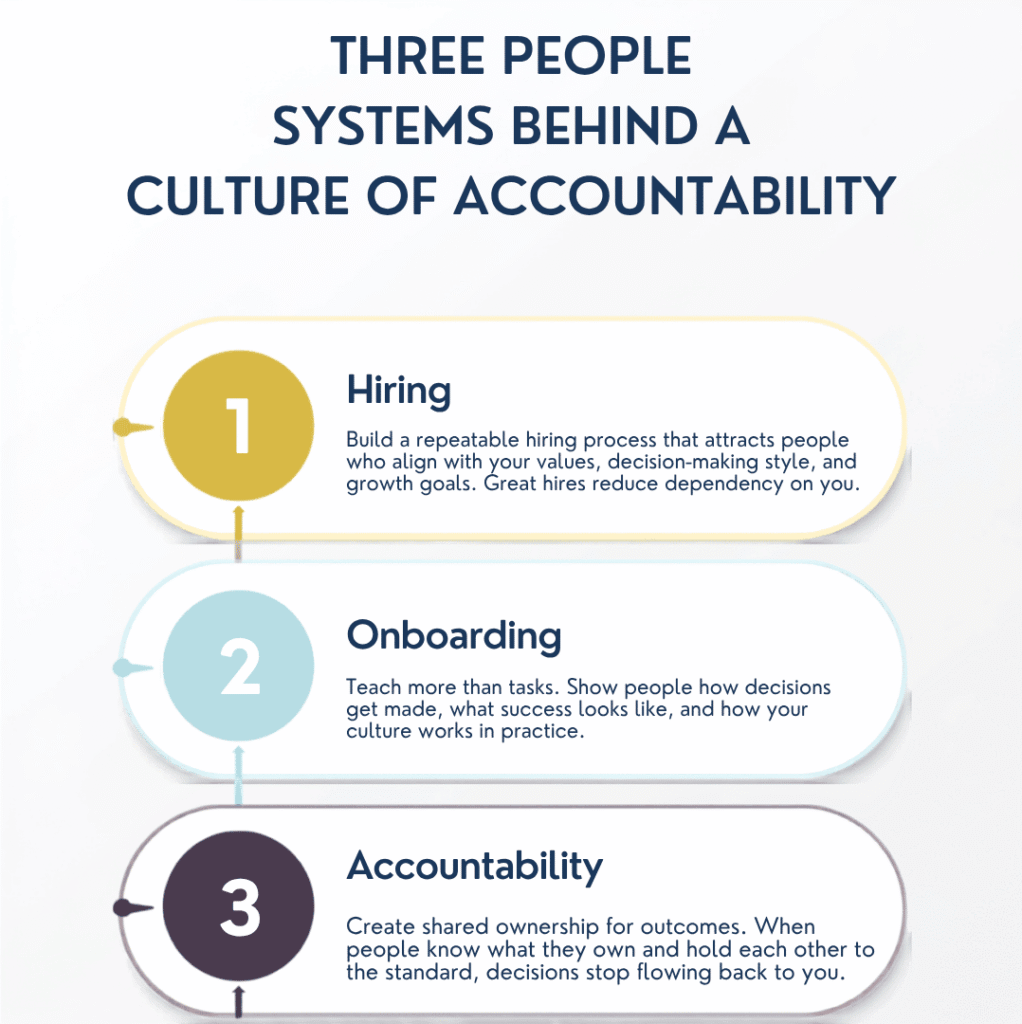
The Three People Systems Behind a Culture of Accountability
Before anything else, a growing company needs three people systems. Build these, and everything gets lighter. Skip them, and everything gets heavier. Together, they are how you stop being the only decision point and share accountability.
1. Hiring Systems
Hiring is one of the most important decisions you make. Too many owners decide they are too senior or too busy to be part of it. But every business is a people business. You need a system here, and you cannot be the bottleneck.
I am a podcast fan, and I watch The Diary of a CEO religiously. I love how Steven Bartlett talks about hiring. I especially love a recent story in which he said he had his brother conduct a financial analysis of why he (Steven) ended up wealthy. What was discovered? Every milestone in Steven’s wealth or business success followed one key similarity – a great hire. And that great hire, in turn, made other key hires. That is, it – not the product or marketing or hard work. It was the hiring. And this young man is building an empire now, at a ridiculously young age!
A consistent process moves you off gambling. It is better for the team and better for the candidates. You do not have to do the hiring yourself. You do need a process you trust that delivers consistent results.
The goal is not a perfect record. Not every hire will fit. But when you miss, you should understand why right away and adjust the process. Modern hiring also means asking a harder question first:
- is this even a full-time role?
- With fractional, project, interim, and artificial intelligence (AI) options, many roles you would have filled with a full-time employee no longer need one.
Don’t go as far as I did and rely on yourself and create a bottleneck, like the story I shared. But, do know that every success I had was also based on hiring, and I have no regrets for always taking it seriously and investing time.
2. Onboarding Systems
The beginning defines the entire employee experience. Setting expectations about culture, the role, and how things get done is a once-in-a-lifetime opportunity.
When new hires learn how decisions work here, not just where the shared drive folder lives, they are set up to win. Onboard well, reinforce your values, and even a weak stretch later will leave you stronger than before. The start sets the tone. Before long, you have a team that is set up and operates consistently.
Onboarding has a side benefit too. Nothing exposes what you have not documented faster. The moment you try to teach it, you realize you lack the clarity to share. That pressure pushes you to prioritize the right practices next.
3. Accountability Systems
Accountability is not supervision. It is not micromanagement. It is not performance management that checks a box. Real accountability is self-led, peer-supported, and values-driven.
This is where creating a culture of accountability changes the math. When people own outcomes and hold each other to a shared standard, the decisions stop flowing back to you. When you hire well and onboard people into your values, strategy, and role, the rest comes far more easily.
Why Traditional Fixes Do Not Work
Hiring more, working harder, adding more meetings. These fail for one reason: if you have not picked the right team and given them what they need to succeed, nothing else matters.
If people lack the clarity and trust to act, they will not act. If they rely solely on checklists and procedures, you breed complacency, which eventually costs you growth and reputation.
And you stay stuck.
Up Next: The Operating System You Already Have
Most owners think they need more structure. What they need are values that work as decision rules, not posters on a wall. Values done right create speed, clarity, confidence, alignment, judgment, accountability, consistency, and a culture that scales without going corporate.
Values are not branding. They are architecture. They are the missing system most owners do not realize they already have.
That is Blog Three.
You are reading Blog Two of The Real Reasons You Are Stuck, a founder-to-owner series on fatigue, flow, and the architecture your business is missing:
- Owner and Founder Fatigue: A Structural Problem, Not a Personal Failure.
- You Don’t Have a People Problem. You Have a Decision Flow Problem.
- Your Values Are More Powerful Than Any Policy: The System Founders Overlook.
- Accountability Isn’t About Oversight, It’s About Freedom: The Three Layers That Scale a Business Without Burning Out the Founder.
Ready to Stop Being the Bottleneck?
You do not need more hours. You need a business that can make good decisions without you in the room.
Two ways to start:
- Start with the diagnostic. Take the DEPEND Assessment. It is a short founder dependency diagnostic across six axes: Decisions, Escalation, Priorities, Energy, Network, and Data. You get a clear read on where you are stuck before you decide what to fix. Take the DEPEND Assessment
- Ready to move now? Book a Leadership Liftoff call and we will map your plan.
About the Author
Jamie L. Smith is the Founder of Double U, a fractional leadership company built to help founders and growing businesses unblock growth, regain leadership capacity, and scale sustainably. After years of working alongside business owners, executive teams, and scaling organizations, Jamie built Double U around one core belief: leaders should not do this alone.

FAQs
Why do I feel busier after hiring more people?
Because the work routing through you grew faster than the clarity your team has to act. More people without a clear decision flow means more questions, and every question lands on you. Fix the decision flow first, and new hires will create capacity.
How do I stop being the bottleneck in my business?
Start with people, not process. Hire with a consistent system, onboard people into how decisions get made, and build real accountability. When your team has the clarity and trust to act, decisions no longer come back to you.
What does creating a culture of accountability mean?
It is not supervision or micromanagement. Real accountability is self-led, peer-supported, and values-driven. People own their outcomes and hold each other to a shared standard, which frees you from being the only check in the system.
Should I build systems and standard operating procedures to scale?
Yes, but not first and not rigidly. Systems without clarity slow everything down and breed busywork. Get the right people, values, and decisions in place, then build lightweight systems on that foundation.
What is leadership architecture?
It is the way decisions, roles, and values are designed so your business can run without every call going through you. Most founder bottlenecks are architectural problems, not people problems.